Industry data show lead-time and price volatility for classic analog ICs has increased significantly, with many buyers seeing year-over-year swings in median unit price and lead times described by procurement teams as expanding by a double‑digit percentage range; this trend signals higher carrying costs and intermittent shortfalls for legacy timers. This report gives engineers and procurement teams a concise, actionable sourcing playbook for the LM555 in the MSOP-8 package: core specs to verify, which KPIs to track, channel tradeoffs, and practical procurement tactics to reduce schedule and quality risk.
Readers will find exact spec lines to confirm on datasheets, recommended monitoring thresholds for price and lead time, a channel‑vetting checklist, and a compact procurement checklist suitable for RFQs and incoming inspection protocols. The tone is direct and data-driven for US buyers focused on pragmatic sourcing decisions.
1 — Product overview & MSOP-8 package specs (Background)
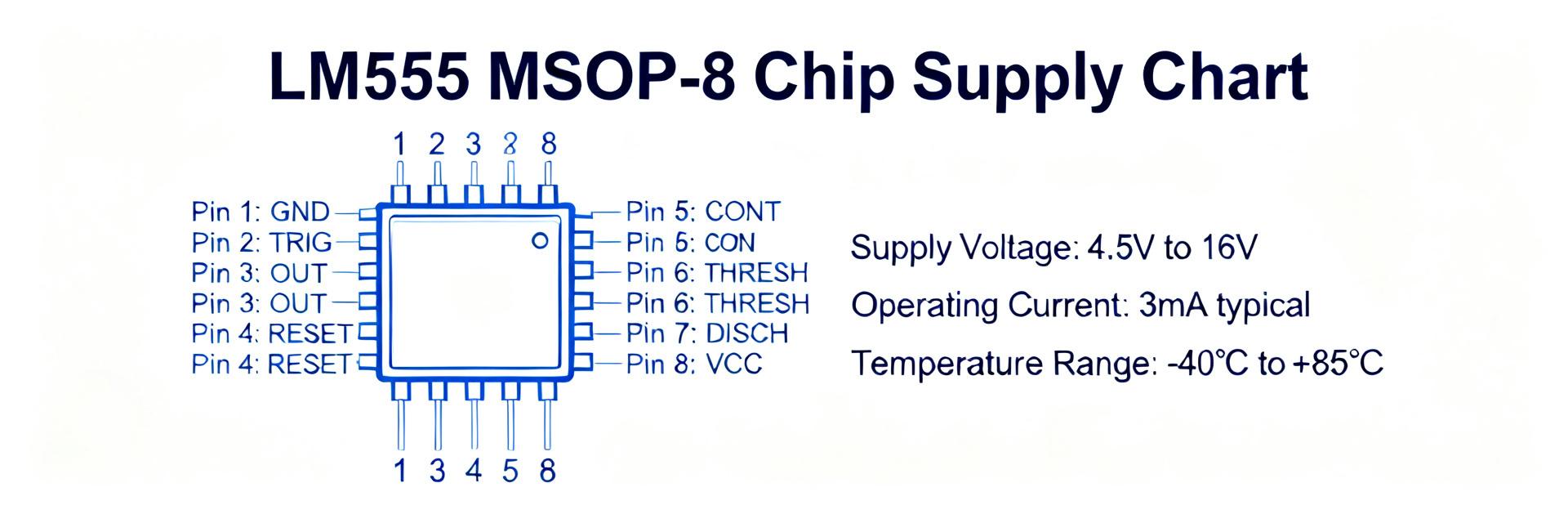
1.1 — LM555 core electrical specs and performance envelope
Point: Confirm VCC, output drive, timing accuracy and input thresholds before approving a part. Evidence: Typical LM555 datasheet lines list supply range, output source/sink capability, threshold/trigger thresholds, and recommended R/C ranges. Explanation: When sourcing, check VCC min/max, output source/sink current, timing capacitor leakage sensitivity and allowable timing resistor ranges; these directly affect interchangeability and functional tests.
1.2 — MSOP-8 mechanical & thermal specifics
Point: Validate footprint, land pattern and thermal limits for MSOP-8 to avoid assembly rework. Evidence: MSOP-8 specifies small body dimensions, recommended PCB land pattern and a maximum solder reflow temperature for the package body. Explanation: Verify pad size, courtyard and solder mask clearance, expected board-level thermal resistance, and maximum peak reflow temp; include a footprint checklist in supplier QA to prevent tombstoning or soldering defects.
2 — Market data & pricing trends for LM555 MSOP-8 (Data analysis)
2.1 — Recent pricing and lead-time trends (what metrics to track)
Point: Track a handful of KPIs monthly to detect emerging supply stress. Evidence: Useful metrics include rolling median unit price (12 months), short‑term price delta, 90/50/10 percentile lead times and order fill rate. Explanation: Visualize with month-over-month sparklines; set triggers such as lead time > 12 weeks or fill rate below 80% to move from spot purchases to safety stock or LTA discussions.
| Sourcing KPI | Target Threshold | Mitigation Action Trigger |
|---|---|---|
| Rolling Median Unit Price | < 1.15x Baseline | Initiate spot buys / alternative qualification if exceeded |
| 90th Percentile Lead Time | < 12 Weeks | Trigger Safety Stock calculations and buffer increases |
| Order Fill Rate | > 90% | Transition to Long-Term Agreements (LTA) if below 80% |
| Supplier Traceability Score | 100% COC Compliant | Enforce 100% inspection for secondary market suppliers |
2.2 — Drivers behind current price/availability (demand, obsolescence, raw materials)
Point: Diagnose root causes to assign procurement priorities. Evidence: Common drivers are continued demand for legacy designs, migration to CMOS equivalents, packaging capacity constraints and lot allocation. Explanation: Create a simple risk rating (High/Medium/Low) for each driver—monitor high drivers weekly, medium monthly—and apply mitigation (safety stock, alternate sourcing) per rating.
3 — Supply chain & sourcing channels (Data analysis / Method)
3.1 — Channel types: authorized distribution, franchised stocking, brokers and excess inventory
Point: Choose channels based on price, traceability and counterfeit risk. Evidence: Authorized channels offer traceability and compliance paperwork; brokers/secondary markets offer availability but higher counterfeit risk. Explanation: Use a vetting checklist that demands trace documentation, date-code photos, lot traceability, and a sample test requirement for any non‑authorized source to reduce risk when urgency drives procurement choices.
3.2 — Risk mitigation: multi-sourcing, contract terms and inventory strategies
Point: Apply multi-layered strategies to limit disruption. Evidence: Tactics include calculated safety stock, long‑term agreements (LTA), consignment and lifecycle tracking for legacy parts. Explanation: Use a recommended minimum safety stock formula (average weekly usage × lead time + safety factor) and trigger LTAs when lead time and price signals exceed defined thresholds to stabilize availability.
4 — Procurement playbook: how to buy LM555 MSOP-8 effectively (Method / Actionable guide)
4.1 — Step-by-step procurement checklist
Point: Standardize RFQs and incoming inspection to reduce defects and mis-buys. Evidence: Essential items: datasheet revision, acceptable date codes, RoHS/compliance declarations, packaging type, and sampling. Explanation: Include required functional spot tests, visual and x‑ray inspection where feasible, and explicit acceptance criteria in RFQs to prevent receiving wrong or out‑of‑spec material.
4.2 — Cost reduction & alternate-sourcing tactics
Point: Balance bulk buys and spot purchases while qualifying substitutes. Evidence: Bulk buys reduce unit cost but increase inventory risk; equivalent timers or package conversions save cost but require validation. Explanation: Evaluate substitutes via an electrical compatibility checklist (timing accuracy, drive capability, pinout), estimate PCB rework impacts and plan a short validation prototype run before full conversion.
5 — Applications, alternatives and compliance considerations (Case studies & action)
5.1 — Typical use cases and why MSOP-8 is chosen
Point: MSOP-8 is selected for compact low-cost timer applications where board space and automatic assembly matter. Evidence: Common end products use the LM555 for simple oscillators, watchdogs and delay circuits in consumer and industrial boards. Explanation: Insist on MSOP-8 where area and pick‑and‑place reliability are critical; otherwise consider larger packages only after evaluating assembly cost tradeoffs.
5.2 — Alternatives, cross-references and regulatory notes
Point: Consider CMOS low-power equivalents or alternate packages when cost, power or obsolescence risk is high. Evidence: Alternatives can offer lower power or smaller supply voltage ranges but may change drive capability or pinout. Explanation: Use a migration plan template—schematic compatibility check, prototype validation and thermal/EM review—before committing to substitutes to ensure system behavior remains acceptable.
Summary
Recap the three practical takeaways: first, confirm critical LM555 electrical specs (VCC min/max, output drive, timing capacitor sensitivity) before purchase; second, monitor price and lead-time KPIs (rolling median price, 90/50/10 lead-time percentiles, fill rate) and apply threshold rules; third, follow a disciplined sourcing checklist with channel vetting, sample testing and a defined safety stock policy. Final actionable recommendation: run a focused 90‑day sourcing audit for LM555 MSOP-8 items, set clear threshold triggers for LTAs or qualified substitutes, and embed the RFQ acceptance criteria into purchase orders to reduce downstream defects and schedule risk.
- Confirm LM555 electrical specs and MSOP-8 footprint details against the datasheet before issuing an RFQ to avoid functional mismatches and PCB rework.
- Track pricing and lead-time KPIs monthly; trigger safety stock or LTA when lead time exceeds the defined procurement threshold to stabilize supply.
- Vet channels with a traceability checklist, require samples and incoming inspection, and maintain a substitution validation plan for low-power or package alternatives.
Frequently Asked Questions
What should I verify on the LM555 datasheet before sourcing?
Verify VCC min/max, typical and absolute output source/sink currents, threshold/trigger voltages, recommended R/C ranges and maximum junction temperature. Require the supplier to confirm datasheet revision and acceptable date codes and include functional spot tests in the purchase terms to validate critical timing behavior on receipt.
How do I set lead-time and price thresholds for LM555 MSOP-8 sourcing?
Use rolling median price over 12 months and monitor month-over-month deltas; for lead time, track 90/50/10 percentiles. Define triggers such as lead time > 12 weeks or price increase > 15% month-over-month to initiate safety stock buys or start LTA negotiations with qualified channels to mitigate risk.
When is it acceptable to substitute the LM555 in MSOP-8 with an alternative?
Substitution is acceptable only after electrical compatibility checks (timing accuracy, drive capability, pinout), a prototype validation run, and an EM/thermal review. Document acceptable date codes and test criteria, and perform incoming functional tests to confirm system-level behavior before approving full production use.
How does the thermal profile of MSOP-8 compare to SOIC-8 during reflow?
MSOP-8 packages have a smaller thermal mass and footprint compared to standard SOIC-8, meaning they are more sensitive to thermal gradients. Designers must strictly adhere to the peak reflow temperature constraints (typically 260°C) and carefully monitor PCB land pattern solder-mask clearances to prevent bridging or tombstoning.


